Why paddock water lines need tougher planning
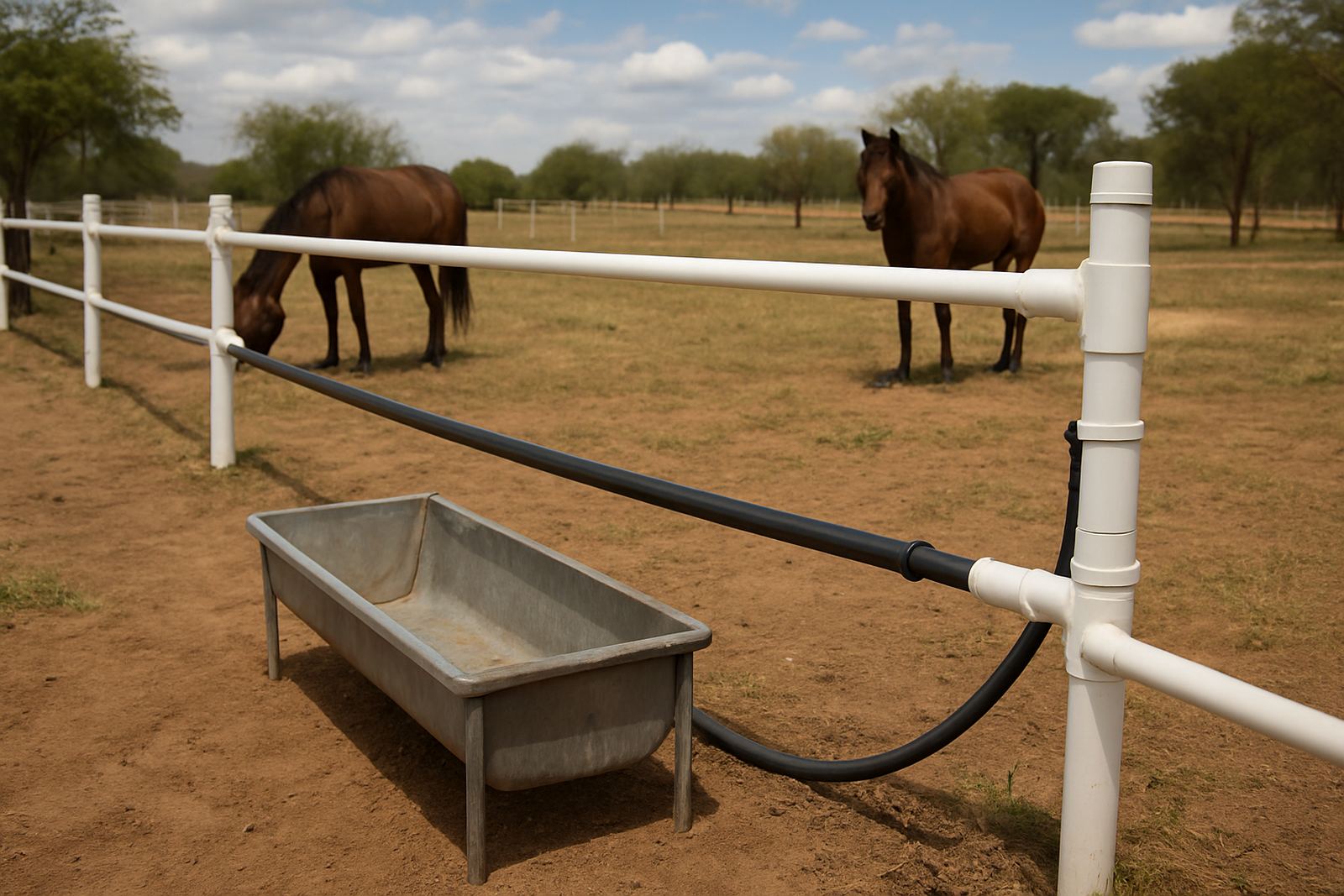
A horse paddock is not the same as a garden block or a simple orchard run. The pipe work sits close to fencing, feeding points, wash bays and often uneven ground, so the layout must cope with knocks, vibration and regular maintenance. In Polokwane, where summer heat and winter dust can dry out exposed sections fast, careful planning helps avoid cracked joints and poor flow at the far end of the line.
For paddock edges and surrounding landscape watering, the aim is to keep the line tidy, protected and easy to service. We see many orders from yard owners who want to move water to troughs, clean-up points or nearby trees without laying a system that becomes a nuisance after the first season.
Typical fittings and tools for a horse paddock setup
A typical paddock order usually includes solvent-weld pipe fittings for branching lines, reducing pieces, elbows, couplers, tees and end caps. For control points, many customers add valves and adaptors so each section can be isolated for cleaning or repairs. For wash areas, extra fittings are often used to create a short, direct line with fewer joins, which lowers the chance of leaks.
- PVC pressure pipe and compatible solvent-weld fittings
- Tees, elbows, couplers, reducers and end caps
- Valves for section control near the paddock edge
- Unions or removable joints for service access
- Cutting, deburring and jointing tools for neat assembly
- Supports, clips and fixings where the line runs above ground
Where the line runs close to livestock movement, a slightly lifted route or protected trench is often better than leaving pipe loose along the ground. That small detail can save a lot of damage later on.
Layout advice for paddock edges, wash bays and shade areas
Good layout starts with knowing where water is really needed. On most horse properties, the main points are paddock borders, wash bays, taps near feed storage, and sometimes a strip of irrigation around the stable yard or shade trees. If the site has long distances, it helps to split the run into shorter sections so pressure stays more even from one end to the other.
When planning for Limpopo conditions, factor in heat, long sunny exposure and the occasional heavy rain that can expose shallow lines. Around Hoedspruit and Thohoyandou, humidity and wet seasons can also affect how fittings are stored and assembled, so clean ends and proper jointing matter. A clean cut and dry fitting check before solvent welding will reduce call-backs later on, and it keeps the line serviceable.
- Keep main lines away from gate swing areas
- Leave access points for flushing and repairs
- Use fewer bends where possible to limit pressure loss
- Mark underground runs before backfilling
- Plan for future paddock division or extra troughs
Common mistakes on horse properties
The most common problem is undersizing the line for the actual distance and water demand. A small setup may look fine on paper, but once several troughs, wash points or landscape outlets are added the pressure drops too far. Another mistake is using too many joints near high-traffic points, where repeated movement and knocking can loosen fittings over time.
We also see systems installed with no proper isolation for each paddock. When one section needs repair, the whole yard ends up off line. In some cases the pipe is left unprotected where a horse can kick it or where tack and equipment are stored, which is asking for trouble. A little more planning upfront is usually cheaper than replacing parts after the first busy season.
Budget ranges in Rand for paddock irrigation supply
Budgets vary a lot depending on distance, pipe size and whether you are feeding one wash bay or a full paddock network. For a small horse yard with basic perimeter watering and a few take-offs, owners often start around R1 500 to R4 500 for fittings and small tools, excluding pipe and labour. A more complete paddock and wash-area setup can move into the R5 000 to R15 000 range once valves, extra branches and service points are included.
For larger farms, especially where runs are long or where multiple paddocks are linked, stock planning is worth doing in batches. That helps avoid short orders and wasted trips. We can assist with quantity checks, product selection and repeat order support, whether the stock is going out from Ladanna, trucked across Limpopo or couriered nationwide.
- Small repair or extension job: from about R1 500
- Basic paddock water line package: about R3 000 to R6 000
- Multi-point yard and wash area setup: about R5 000 to R15 000
- Larger farm order with spares: quoted to size
Getting the right stock from Ladanna to your site
From our Ladanna base in Polokwane, we help farmers, landscapers and contractors match the fittings to the job before stock goes out. That includes reserving items, checking quantities and making sure the fittings suit the pipe and layout you are using. For regular buyers, contractor accounts and repeat order support make it easier to keep spare parts on hand for busy seasons.
Deliveries run through Polokwane, Mokopane, Tzaneen, Hoedspruit, Lephalale and Thohoyandou, with courier dispatch nationwide for customers further afield. If you are setting up horse paddocks, a quick enquiry through the contact page is the simplest way to get advice on the parts that fit your ground, your water source and your maintenance routine.
Mpho Sekgobela and the team can help with product selection, jointing advice and troubleshooting help when you are not sure which fittings to use. It is often the difference between a system that works for years and one that gives problems after the first hot spell.