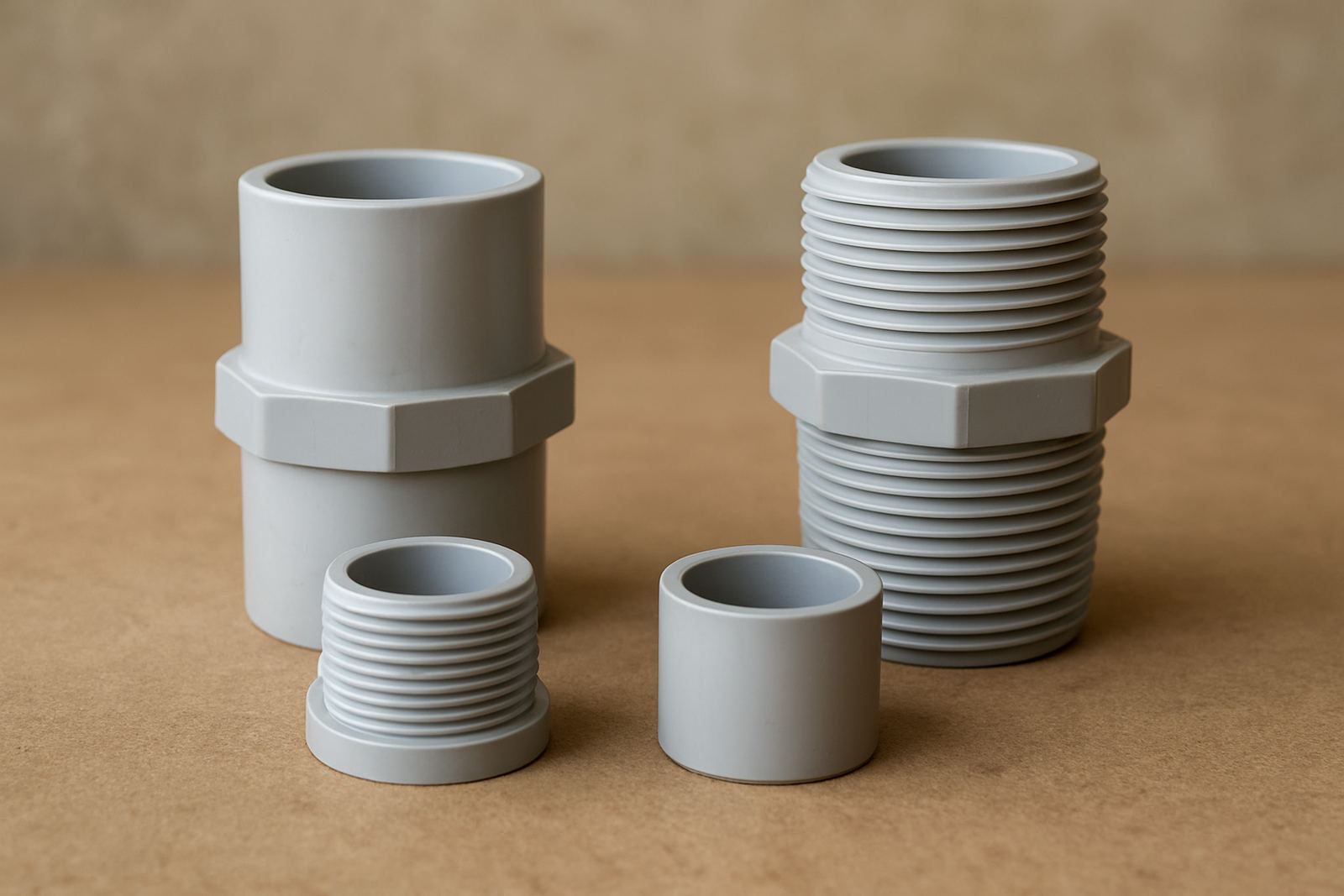
Why adaptor type matters before you cut and glue
In irrigation work, an adaptor is often the part that links pipe to valve gear, threaded fittings, tanks or pumps. The type you choose affects how the connection fits, how many joints you need, and whether the line can be serviced later without cutting pipe again. On a farm in Limpopo, that matters because once the trench is backfilled or the line is already running, a wrong fitting costs time and labour.
Female and male adaptors are not interchangeable. They do opposite jobs in the connection. A female adaptor receives a male threaded end, while a male adaptor screws into a female threaded component. It sounds simple, but the mistake usually happens when people order by size only and do not check the thread form or the side that must mate with the existing part.
- Check the pipe size and the thread size separately
- Confirm whether the mating part is male or female
- Allow for solvent weld, threaded or mixed connection points
- Keep a sample fitting on site when ordering more stock
What a female adaptor does in an irrigation line
A female adaptor has internal threads. In practical use, it is the receiving end. You will often use it where a pipe line must connect to a male threaded valve, filter, metre, pump fitting or tank outlet. The solvent-weld side joins to PVC pipe, while the threaded side accepts the male piece.
For contractors, female adaptors are useful when the equipment side is fixed and the pipe side is being built around it. They help keep the assembly neat and they make replacement easier later. On a citrus block near Tzaneen, for example, a female adaptor can help tie a mainline into a threaded control point without changing the whole assembly.
- Best suited to external male threads
- Common at pump rooms, valve points and tank outlets
- Useful where later disassembly may be needed
- Available in sizes that must match the pipe and thread exactly
What a male adaptor does and where it saves time
A male adaptor has external threads. It is the part that goes into a female threaded fitting. You will use it when the pipe side needs to offer a threaded end to something that already has an internal thread. This is common in irrigation maintenance, extensions and quick tie-ins where the existing equipment cannot be altered.
Male adaptors are often chosen when a line must connect to a female socket on a valve body or accessory. They are also handy in repair work because they can help you keep the old fitting in place while replacing only the pipe side. That saves labour and reduces the chance of breaking surrounding parts, especially on older systems where fittings may already be brittle from sun exposure and age.
- Best suited to external female threads
- Good for repairs and extensions
- Handy when equipment must stay in place
- Useful for neat, direct connections in tight spaces
Thread side, pipe side and solvent weld side are not the same thing
Many ordering mistakes happen because people focus on the threaded end and forget the pipe end. An adaptor has two jobs at once. One side must match the pipe by diameter and solvent-weld method, while the other side must match the thread by type and direction. If either side is wrong, the fitting will not work as intended.
It also helps to remember that not all threads behave the same. Even when the size sounds correct, the thread form and seating style need to match. A fitting that feels almost right can still leak, cross-thread or bind before it seals properly. That becomes a bigger problem on systems that must run under pressure for long periods, or where water supply is already limited during load-shedding and pump schedules need careful planning.
- Match pipe diameter first
- Match thread size and thread type second
- Check whether the fitting is straight or reducing
- Do not force a thread that starts to bind
How to avoid ordering the wrong adaptor on a farm or site
The simplest way to avoid an error is to work from the existing fitting, not from memory. Take the old part off, look at both ends, and measure it properly. If the job is spread across several blocks or a few kilometres apart, label the fittings by line number or area before you send the order through. That saves a lot of back-and-forth later.
In Polokwane and surrounding supply routes, this is especially useful when a contractor is collecting for more than one site. A difference of just one adaptor type can delay work in Mokopane, Tzaneen or Hoedspruit if the wrong box gets packed. We often see the same issue on mixed systems where a repair on one line needs a female adaptor and the next line needs a male one, so keep the old sample nearby. It helps more than guessing.
- Send a clear list with sizes and quantities
- Separate female and male parts on the order
- Keep one sample from the site for comparison
- Ask for quantity checks before collection or dispatch
Local conditions that affect fitting choice and life span
South African irrigation systems do not all face the same conditions. In Limpopo, high sun exposure, dust, hard water in some areas and long runs between blocks all place pressure on fittings. On the Lowveld side, heat can accelerate wear on exposed components. In coastal areas outside the province, humidity and salt air can affect metal parts around the PVC line, so a clean threaded connection becomes even more important.
For outdoor use, the aim is always the same: choose the adaptor that fits correctly and can stay serviceable. A fitting that is easy to install but wrong at the thread end can create leaks, stress on the joint and later breakages. A proper match gives you a cleaner line and fewer call-backs, which matters to farmers and contractors working to tight deadlines.
When in doubt, compare the connector on site with the one in hand, then match by size, gender and application. That small discipline avoids a lot of wasted travel and stops the job from stalling halfway through a block.
When to ask for jointing advice before the truck leaves
If your order includes mixed adaptors, reducers, valves or accessory fittings, it is worth checking the full list before dispatch. That is especially true for farm order planning where one missed piece can stop several people from finishing the line. A quick review helps with stock reserving, regional delivery and courier dispatch, particularly when the same project needs parts sent to different points.
Ask for help when the system includes a combination of threaded connections, older pipework or repeated repairs. It is better to spend a few minutes confirming the adaptor type than to cut out a section and start again. On irrigation work, accuracy saves water, time and labour, and that is usually the difference between a smooth day and a long one.
- Use support when the system mixes old and new fittings
- Check the adaptor type before solvent welding
- Confirm quantities for repeat orders and contractor accounts
- Plan spares for future repairs, not only the current install